Share:
Not all naps are created equal. The timing, duration, and technique of your nap determines whether you wake up refreshed and sharp or groggy and disoriented. Here is what sleep science says about napping right.
# The Science of Napping: How to Nap for Peak Performance and Recovery
Napping has a complicated reputation. In many Western cultures, it is associated with laziness or a sign that you are not getting enough done. Yet some of the world's most productive and high-performing individuals — from Winston Churchill and Albert Einstein to Arianna Huffington and LeBron James — have been devoted nappers. And the science is unambiguously on their side.
A well-timed, appropriately-dosed nap is one of the most powerful performance enhancement tools available — completely free, with no side effects, and backed by decades of rigorous research. The key is understanding the science so you can nap strategically rather than accidentally.
## Why We Feel Sleepy in the Afternoon
Before understanding how to nap effectively, it helps to understand why we feel sleepy in the early-to-mid afternoon in the first place. This post-lunch dip in alertness — typically occurring between 1:00 and 3:00 PM — is not caused by eating lunch. It is a biological phenomenon driven by the circadian rhythm.
The circadian rhythm, governed by the suprachiasmatic nucleus (SCN) in the hypothalamus, produces two peaks of alertness per day (typically mid-morning and early evening) and two troughs (the early afternoon and the middle of the night). This biphasic pattern is universal across human cultures and is thought to reflect an evolutionary adaptation — many traditional cultures practice midday rest as a matter of course.
The afternoon dip is compounded by **adenosine buildup** — the sleep-pressure molecule that accumulates in the brain from the moment you wake up. By early afternoon, adenosine levels are high enough to create noticeable drowsiness, particularly if you are sleep-deprived.
## What Happens During a Nap: Sleep Stages and Timing
The effects of a nap depend critically on its duration, because different sleep stages occur at different points in the nap:
**Stage 1 (N1): 1–5 minutes.** Light sleep, easily disrupted. You may experience hypnic jerks (the sudden muscle twitches that sometimes occur as you fall asleep). Not particularly restorative on its own.
**Stage 2 (N2): 5–25 minutes.** Characterized by sleep spindles and K-complexes — brain wave patterns associated with memory consolidation and sensory processing. This is the sweet spot for most performance-enhancing naps. Body temperature drops, heart rate slows, and the brain begins consolidating recent memories.
**Stage 3 (N3): 25–45 minutes.** Slow-wave sleep (SWS), the deepest and most physically restorative stage. Growth hormone is released, immune function is enhanced, and cellular repair occurs. However, waking from SWS causes **sleep inertia** — the grogginess and cognitive impairment that can last 15–30 minutes after waking.
**REM sleep: 45–90+ minutes.** Rapid Eye Movement sleep, associated with emotional processing, creative insight, and procedural memory consolidation. Typically not reached in short naps unless you are significantly sleep-deprived.
## The Nap Duration Guide
Understanding sleep stages allows you to engineer your nap for specific outcomes:
| Nap Duration | Sleep Stages Reached | Best For | Sleep Inertia Risk |
|---|---|---|---|
| 10–20 minutes | N1, early N2 | Quick alertness boost, mood | Very low |
| 20–30 minutes | N2 | Cognitive performance, memory | Low |
| 60 minutes | N2, N3 | Physical recovery, immune function | Moderate |
| 90 minutes | Full cycle (N1-N3-REM) | Creativity, emotional processing | Low (wakes at cycle end) |
**The 20-minute "power nap"** is the most practical for most people. It provides significant cognitive and alertness benefits — studies show 20-minute naps improve reaction time, logical reasoning, and working memory by 20–40% — while minimizing sleep inertia risk. NASA research on military pilots found that a 40-minute nap improved performance by 34% and alertness by 100%.
**The 90-minute nap** is the gold standard for recovery and creativity. By completing a full sleep cycle, you wake at the lightest stage of sleep, minimizing grogginess. This duration is particularly valuable for athletes, shift workers, or anyone significantly sleep-deprived. Research on medical residents found that a 90-minute nap reduced errors and improved clinical performance comparably to a full night's sleep.
**The "nappuccino" or "coffee nap"** is a clever technique that combines caffeine with a short nap. You drink a cup of coffee immediately before a 20-minute nap. Caffeine takes approximately 20–30 minutes to be absorbed and block adenosine receptors, so it kicks in just as you wake up — providing both the benefits of the nap and the alertness boost of caffeine simultaneously. Studies show this combination is more effective than either napping or caffeine alone.
## Timing Your Nap: The Circadian Window
The timing of your nap matters as much as its duration. The optimal napping window is aligned with the natural circadian dip — typically between 1:00 PM and 3:00 PM for most people. Napping within this window:
1. Takes advantage of naturally elevated sleep pressure, making it easier to fall asleep quickly
2. Minimizes interference with nighttime sleep (napping too late in the afternoon can reduce sleep pressure at bedtime)
3. Aligns with the body's natural temperature nadir, which facilitates sleep onset
Napping after 3:00–4:00 PM is generally not recommended for people who go to bed at a normal time (10:00 PM–midnight), as it can reduce adenosine levels enough to delay sleep onset and reduce deep sleep at night.
## Napping for Athletic Performance and Recovery
For athletes and physically active individuals, napping is a legitimate performance enhancement strategy. Research in elite athletes shows:
- A 30-minute nap after a morning training session improves afternoon training performance by 5–10%
- Napping increases sprint speed, reaction time, and technical skill execution
- Post-exercise napping accelerates muscle glycogen resynthesis and reduces markers of muscle damage
- Sleep extension through napping is associated with improved mood, reduced perceived exertion, and faster reaction times
Many elite sports organizations — including Premier League football clubs, NBA teams, and Olympic training centers — now incorporate structured napping protocols into their athlete recovery programs.
## Overcoming Common Napping Challenges
**"I can't fall asleep during the day."** Many people who believe they cannot nap simply have not created the right conditions. A cool, dark room, a sleep mask and earplugs, and lying down (rather than sitting) dramatically increase the likelihood of falling asleep. Even if you do not fully fall asleep, lying quietly with eyes closed for 20 minutes provides measurable cognitive and physiological benefits through a state called **quiet wakefulness** or **rest without sleep**.
**"I always wake up groggy after naps."** This is almost certainly because you are napping too long and waking from deep sleep. Strictly limiting naps to 20 minutes (set an alarm) or extending to a full 90-minute cycle will largely eliminate sleep inertia.
**"I feel guilty napping during the day."** The cultural stigma around napping is not supported by science. Napping is not a sign of laziness — it is a sign of biological intelligence. The most productive thing you can do in the early afternoon may be to rest for 20 minutes rather than push through diminishing cognitive returns.
**"Napping makes it hard to sleep at night."** This is only true if you nap too late or too long. A 20-minute nap before 3:00 PM has minimal impact on nighttime sleep in most people. If you are chronically sleep-deprived, napping may actually improve nighttime sleep quality by reducing the anxiety and hyperarousal associated with sleep deprivation.
## Building a Napping Practice
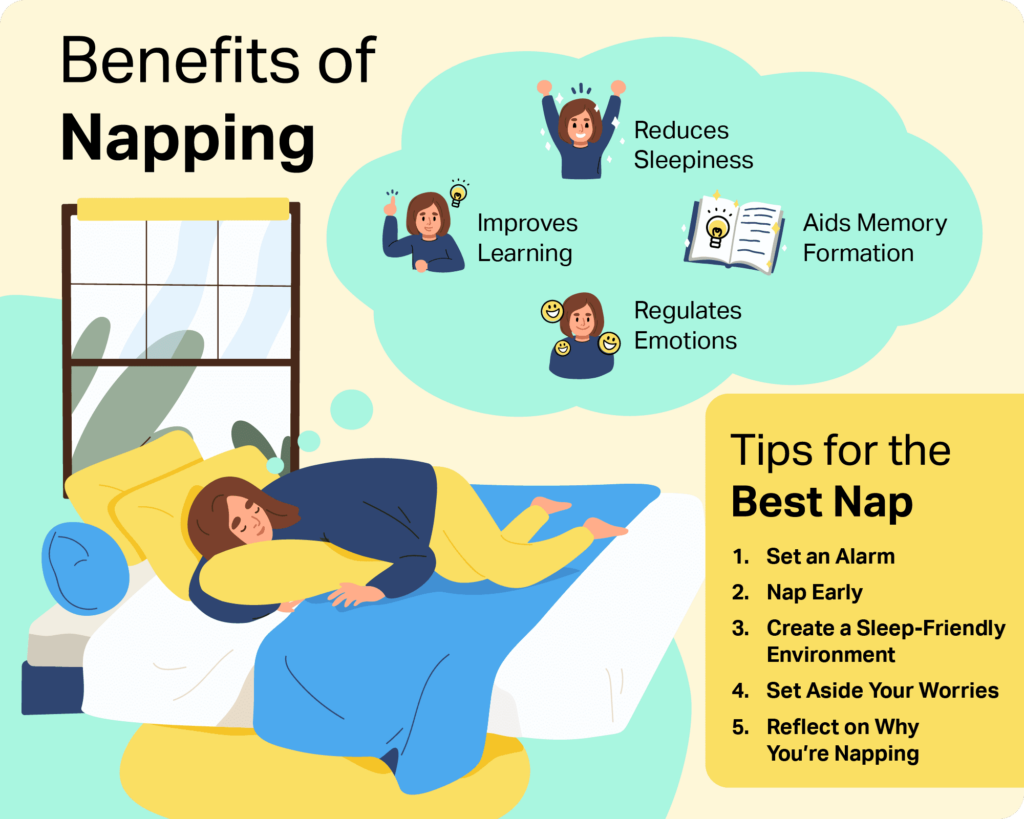
For those who want to incorporate napping into their routine, a simple protocol works well for most people: identify your natural afternoon energy dip (usually 6–8 hours after waking), set a 20-minute alarm, lie down in a cool and dark environment, and use an eye mask and earplugs if needed. If you want to try the nappuccino, drink your coffee immediately before lying down.
Consistency matters — regular nappers fall asleep faster and experience greater cognitive benefits than occasional nappers, likely because the body learns to enter sleep quickly during the scheduled rest period.
Napping is not a substitute for adequate nighttime sleep. But as a complement to a healthy sleep routine, a well-timed nap is one of the most evidence-based, accessible, and underutilized tools for cognitive performance, physical recovery, and overall wellbeing.
Written by
Coach Daniel Park
Health & wellness expert contributing evidence-based content to Health Hub.