Share:
Sleep is not a passive state of unconsciousness — it is an active, highly organized biological process with distinct stages, each serving critical functions for brain health, physical recovery, and emotional regulation.
# Sleep Stages Explained: What Your Brain and Body Do While You Sleep
For most of human history, sleep was considered a passive state — a period of inactivity during which the body simply rested and the mind went quiet. The development of electroencephalography (EEG) in the 1920s and the discovery of rapid eye movement (REM) sleep in 1953 by Eugene Aserinsky and Nathaniel Kleitman shattered this view entirely. Sleep, it turned out, is one of the most active and complex biological processes in the human body — a precisely orchestrated sequence of brain states, each serving functions so critical that their disruption produces rapid and severe physiological consequences.
Understanding what happens during each stage of sleep is not merely academic. It provides the foundation for understanding why sleep quality matters as much as sleep quantity, why certain sleep disorders are so damaging, and what you can do to maximize the restorative value of every hour you spend in bed.
## The Architecture of Sleep: An Overview
Sleep is organized into cycles, each lasting approximately 90 minutes, that repeat 4–6 times over a typical 7–9 hour night. Each cycle consists of two broad categories of sleep: **non-REM (NREM) sleep**, which itself has three stages (N1, N2, and N3), and **REM sleep**.
The proportion of each stage changes across the night. Early cycles are dominated by deep NREM sleep (N3), while later cycles contain more REM sleep. This is why the last 1–2 hours of sleep are disproportionately rich in REM — and why cutting sleep short by even 90 minutes can eliminate a significant portion of your total REM sleep for the night.
## Stage N1: The Gateway to Sleep (1–7 minutes)
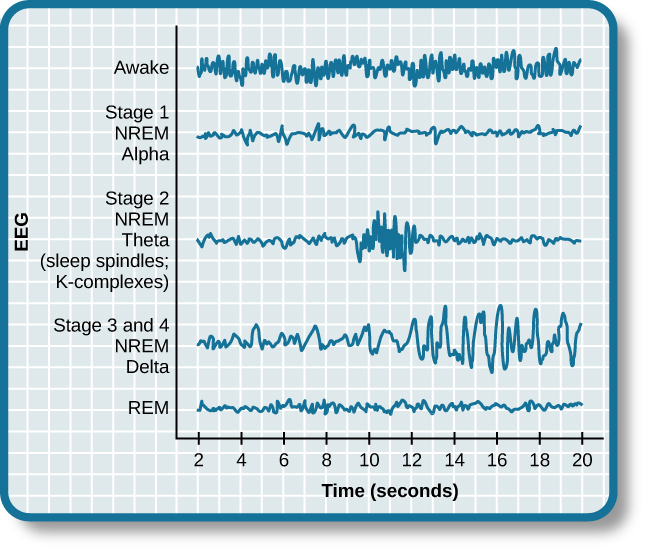
N1 is the lightest stage of sleep — the transition zone between wakefulness and sleep. During N1, the brain shifts from the alert beta waves of wakefulness to slower alpha waves, and then to the even slower theta waves characteristic of light sleep. Muscle activity decreases, the eyes move slowly, and awareness of the external environment fades.
N1 is easily disrupted. A noise, a touch, or a change in light can return the sleeper to full wakefulness. Many people who are awakened from N1 report that they were not asleep at all — a phenomenon that contributes to the subjective experience of insomnia.
A distinctive feature of N1 is the **hypnic jerk** — the sudden, involuntary muscle contraction that many people experience as they drift off to sleep, sometimes accompanied by a sensation of falling. Hypnic jerks are thought to be a normal neurological phenomenon related to the transition from wakefulness to sleep, though their exact cause remains debated.
N1 typically accounts for 5–10% of total sleep time. Its primary function appears to be transitional — preparing the brain and body for deeper sleep stages.
## Stage N2: The Foundation of Sleep (45–55% of total sleep)
N2 is the most abundant sleep stage, accounting for nearly half of total sleep time in healthy adults. It is characterized by two distinctive EEG patterns: **sleep spindles** and **K-complexes**.
**Sleep spindles** are bursts of oscillatory neural activity (12–15 Hz) lasting 0.5–3 seconds, generated by interactions between the thalamus and cortex. They are among the most studied phenomena in sleep science, and for good reason: spindle density and frequency are strongly correlated with cognitive performance, particularly memory consolidation and intelligence. People with higher spindle activity show better declarative memory consolidation — the process by which recently learned information is transferred from short-term to long-term memory. Sleep spindle density declines with age, which may contribute to age-related memory decline.
**K-complexes** are large, sharp EEG waves that appear spontaneously or in response to external stimuli. They are thought to serve a dual function: suppressing arousal in response to non-threatening stimuli (allowing sleep to continue) while simultaneously facilitating memory consolidation.
During N2, heart rate slows, body temperature drops, and the body begins to prepare for deep sleep. Importantly, N2 is the stage during which **motor sequence learning** — the consolidation of procedural skills like playing a musical instrument or learning a new sport — primarily occurs. This is why a good night's sleep after practicing a new skill dramatically improves performance the following day.
## Stage N3: Deep Sleep (Slow-Wave Sleep) — The Physical Restoration Stage
N3, also called **slow-wave sleep (SWS)** or **deep sleep**, is characterized by high-amplitude, low-frequency delta waves (0.5–4 Hz). It is the most physically restorative stage of sleep and the hardest to wake from — someone awakened from N3 typically experiences **sleep inertia**, a period of grogginess and cognitive impairment that can last 15–30 minutes.
The biological events during N3 are remarkable in their scope and importance:
**Growth hormone secretion** reaches its peak during N3. The majority of the day's growth hormone — which is essential for tissue repair, muscle growth, bone density, and immune function — is released in a single large pulse during the first deep sleep cycle of the night. This is why sleep deprivation impairs physical recovery and muscle building, and why athletes who sleep poorly show slower recovery from training.
**Immune system activation** is heightened during N3. T-cell production, cytokine release, and the formation of immunological memory (the process by which the immune system "remembers" pathogens and vaccines) all occur preferentially during slow-wave sleep. Studies have shown that people who sleep fewer than 6 hours per night are 4 times more likely to develop a cold when exposed to a rhinovirus compared to those who sleep 7 or more hours.
**Glymphatic clearance** — the brain's waste removal system — is most active during N3. The glymphatic system uses cerebrospinal fluid to flush metabolic waste products from the brain, including amyloid-beta and tau — the proteins that accumulate in Alzheimer's disease. Sleep deprivation impairs glymphatic clearance and accelerates amyloid accumulation in the brain.
**Memory consolidation of declarative memories** (facts and events) also occurs during N3, through a process called **memory replay** in which the hippocampus re-activates recently encoded memories and transfers them to the neocortex for long-term storage.
N3 is most abundant in the first half of the night and in young adults. It declines significantly with age — by the 60s, many people have lost 60–70% of their N3 sleep compared to young adulthood — which is one reason why older adults are more susceptible to illness, cognitive decline, and slower physical recovery.
## REM Sleep: The Brain's Nightly Therapy Session
REM sleep is perhaps the most fascinating and least understood stage of sleep. Named for the rapid, darting eye movements that characterize it, REM sleep is paradoxically a state of intense brain activity — EEG patterns during REM resemble those of alert wakefulness — combined with near-complete muscle paralysis (atonia), which prevents the sleeper from acting out their dreams.
REM sleep serves several critical functions:
**Emotional memory processing.** REM sleep is the stage during which the emotional charge of memories is processed and regulated. The norepinephrine system — which drives the stress and fear response — is uniquely inactive during REM sleep, creating what neuroscientist Matthew Walker has called a "safe space" for the brain to re-process emotionally charged memories without the physiological stress response. This is thought to be why REM sleep is critical for emotional resilience and why REM sleep deprivation is associated with heightened emotional reactivity, anxiety, and PTSD symptom severity.
**Creative insight and problem-solving.** REM sleep is associated with the formation of novel associations between distantly related concepts — the neural basis of creative insight. Studies have shown that people awakened from REM sleep perform significantly better on creative problem-solving tasks than those awakened from NREM sleep or those who have not slept. The famous examples of creative breakthroughs during sleep — Kekulé's discovery of the benzene ring structure, Paul McCartney's composition of "Yesterday" — are thought to reflect REM-mediated associative processing.
**Procedural memory consolidation.** While N2 handles motor sequence learning, REM sleep consolidates more complex procedural skills and the integration of new skills with existing knowledge.
**Brain development.** Newborns spend approximately 50% of their sleep time in REM (compared to 20–25% in adults), and premature infants spend even more. This suggests that REM sleep plays a critical role in brain development and synaptic pruning during early life.
## What Disrupts Sleep Architecture
Many common factors disrupt the normal progression through sleep stages:
| Disruptor | Primary Effect on Sleep Architecture |
|---|---|
| Alcohol | Suppresses REM sleep in first half of night; increases N3 initially but fragments sleep overall |
| Cannabis (THC) | Suppresses REM sleep; reduces dream recall |
| Benzodiazepines | Suppresses N3 and REM; increases N2 |
| Blue light exposure | Delays sleep onset; reduces N3 and REM |
| Caffeine (late day) | Delays sleep onset; reduces N3 |
| Sleep apnea | Fragments all stages; severely reduces N3 and REM |
| Stress/cortisol | Reduces N3; increases light sleep and awakenings |
| Aging | Reduces N3 significantly; modestly reduces REM |
Alcohol deserves special mention because it is widely used as a sleep aid, yet its effects on sleep architecture are profoundly disruptive. While alcohol does accelerate sleep onset and increase N3 in the first half of the night, it dramatically suppresses REM sleep — particularly in the second half of the night when REM cycles are longest. The result is sleep that feels deeper initially but leaves the sleeper deprived of the emotional processing and creative consolidation that REM provides.
## Optimizing Your Sleep Architecture
Understanding sleep stages suggests several practical strategies for maximizing sleep quality:
Protect your sleep duration — particularly the last 1–2 hours of the night, which are disproportionately rich in REM sleep. Even modest sleep restriction (6 hours instead of 8) eliminates a disproportionate amount of REM.
Avoid alcohol within 3 hours of bedtime. Even moderate alcohol consumption significantly suppresses REM sleep and fragments sleep architecture in the second half of the night.
Maintain a cool bedroom temperature (65–68°F / 18–20°C). Core body temperature must drop by 1–2°F to initiate and maintain deep sleep. A cool environment facilitates this drop.
Exercise regularly, but not within 2–3 hours of bedtime. Regular aerobic exercise significantly increases N3 sleep and improves overall sleep architecture. Late-evening vigorous exercise can delay sleep onset by elevating core body temperature and cortisol.
Manage stress and anxiety. Elevated cortisol and hyperarousal are among the most common causes of reduced N3 and fragmented sleep. Mindfulness, cognitive behavioral therapy for insomnia (CBT-I), and relaxation practices can meaningfully improve sleep architecture by reducing pre-sleep arousal.
Written by
Dr. Elena Vasquez
Health & wellness expert contributing evidence-based content to Health Hub.